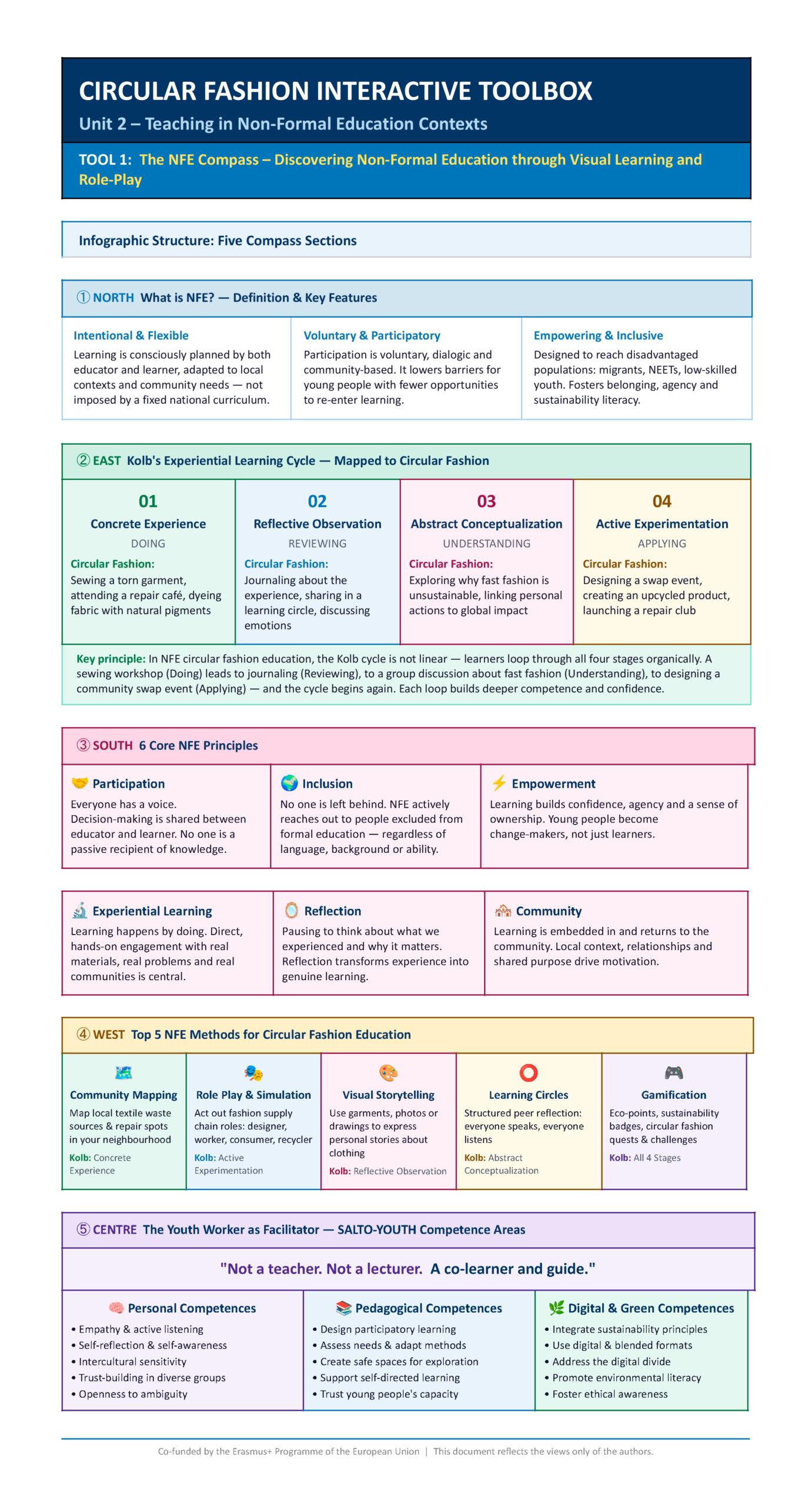
The compass sets out non-formal education in five directions: what it is, how learning moves through the Kolb cycle, the six principles it rests on, five methods that work particularly well in circular fashion, and what kind of educator it asks for. Read it once through before you start.
Council of Europe. Compass: Manual for Human Rights Education with Young People.
SALTO-YOUTH. T-Kit on Non-Formal Education.
McLeod, S. Kolb’s Learning Styles and Experiential Learning Cycle. Simply Psychology.
European Commission (2018). Key Competences for Lifelong Learning.
Watch the video first. Then complete the activities below. Each completed step unlocks the next one.
UNESCO. Non-formal education.
Council of Europe (2020). Youth Work Essentials: Non-Formal Education in Practice.
CEDEFOP. European Guidelines for Validating Non-Formal and Informal Learning.
European Youth Foundation. Inclusion and Diversity in Youth Work.
Circular Stories from Our World — Three communities, three cities, one idea. Open each story and read or watch it before you go on.
Circular Fashion Collective, İstanbul.
Interreg Europe. M-Fair: a yearly fair and circular fashion festival (good practice).
Ellen MacArthur Foundation. A New Textiles Economy: Redesigning Fashion’s Future.
European Commission. Erasmus+ Inclusion and Diversity Strategy (Youth).
Co-funded by the European Union. Views and opinions expressed are however those of the author(s) only and do not necessarily reflect those of the European Union or the European Education and Culture Executive Agency (EACEA). Neither the European Union nor EACEA can be held responsible for them.
Project Number: 2024-1-DE02-KA220-ADU-000257214