Teaching in non-formal
education contexts

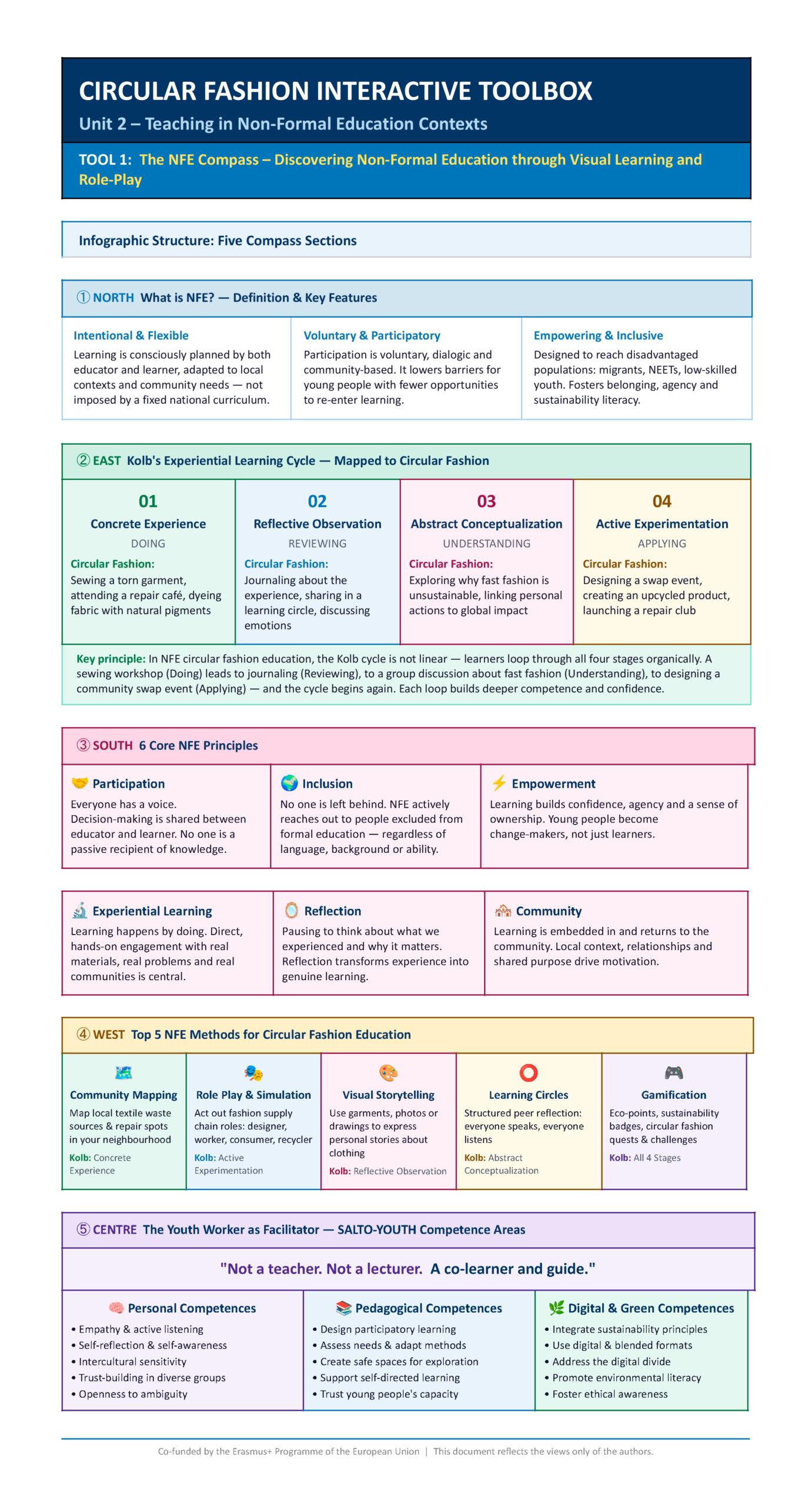
TOOL 1: The NFE Compass: Discovering Non-Formal Education through Visual Learning

Multimedia resource & interactive activity

Instructions:

The compass sets out non-formal education in five directions: what it is, how learning moves through the Kolb cycle, the six principles it rests on, five methods that work particularly well in circular fashion, and what kind of educator it asks for. Read it once through before you start.

Useful readings

Council of Europe. Compass: Manual for Human Rights Education with Young People.

SALTO-YOUTH. T-Kit on Non-Formal Education.

McLeod, S. Kolb’s Learning Styles and Experiential Learning Cycle. Simply Psychology.

European Commission (2018). Key Competences for Lifelong Learning.

Self-Reflection

  1. Think of something important you learned outside a classroom. What made it stick — the place, the people, or the fact that you chose to be there?
  2. Which of the six principles matters most to you, and why?
  3. Where are you strongest on the Kolb cycle: doing, reflecting, making sense of things, or trying them out? Which part do you tend to skip?
  4. Who has taught you something without either of you calling it teaching?
  5. Name one thing you will do differently the next time you are learning alongside other young people.

TOOL 2: My Learning Map: Exploring Where and How We Really Learn

Multimedia resource & interactive activity

Instructions:

Watch the video first. Then complete the activities below. Each completed step unlocks the next one.

Useful readings

UNESCO. Non-formal education.

Council of Europe (2020). Youth Work Essentials: Non-Formal Education in Practice.

CEDEFOP. European Guidelines for Validating Non-Formal and Informal Learning.

European Youth Foundation. Inclusion and Diversity in Youth Work.

Greenwashing Self-Reflection

  1. Looking at your map, which experience changed you most? Was it the place, the people, or the freedom to try something without being marked on it?
  2. Were there places on your map you had never counted as real learning before? What changes if you do count them?
  3. Have you ever felt shut out of formal education? What did you learn elsewhere during that time?
  4. What can you do that no certificate of yours shows?
  5. What would it take for the circular fashion place you added to your map to actually exist near you?

TOOL 3: Circular Stories from Our World: Community Story Mapping and Scenario-Based Learning

Multimedia resource & interactive activity

Circular Stories from Our World —  Three communities, three cities, one idea. Open each story and read or watch it before you go on.

  • İstanbul — Circular Fashion Collective. Community workshops that put traditional craft skills to work in circular fashion, run together with migrants, young people and long-standing residents. devridaim.com.tr
  • Mechelen — M-Fair. A yearly fair and circular fashion festival built around upcycling, repair and community participation.
  • Prato — (Re)made in Italy. Textile recycling grown out of generations of local know-how, now supplying a European circular textile economy.

Useful readings

Circular Fashion Collective, İstanbul.

Interreg Europe. M-Fair: a yearly fair and circular fashion festival (good practice).

Ellen MacArthur Foundation. A New Textiles Economy: Redesigning Fashion’s Future.

European Commission. Erasmus+ Inclusion and Diversity Strategy (Youth).
Self-reflection questions:

  1. Across the three cities, what stayed with you? Did anything remind you of where you live?
  2. In the three situations, what did you assume about the young people described before you read the options? What might change if you asked them first?
  3. What is the first realistic step towards the local idea you wrote down — and who would you need on your side to take it?
  4. The Collective in İstanbul says that what is old for one becomes new for another. Beyond clothes, who near you has knowledge or skills that other people could use?
  5. After finishing this unit, what does circular fashion learning mean to you — as a learner, and as someone other people might learn from?

Co-funded by the European Union. Views and opinions expressed are however those of the author(s) only and do not necessarily reflect those of the European Union or the European Education and Culture Executive Agency (EACEA). Neither the European Union nor EACEA can be held responsible for them.

Project Number: 2024-1-DE02-KA220-ADU-000257214