Circular fashion as a tool for
Social Change and Empowerment

TOOL 1: MIGRANT INCLUSION FALLS

Multimedia resource & interactive activity

Useful readings

– European Migration Network Belgium. (2022). Integration of migrant women in Belgium: Policies and measures.

– Ferolla Vallandro do Valle, M. (2025). Structural discrimination as a barrier to the socio-economic inclusion of migrants: Deepening the impact of human rights law. International Journal of Discrimination and the Law, 25(2), 112–133.

Self-Reflection

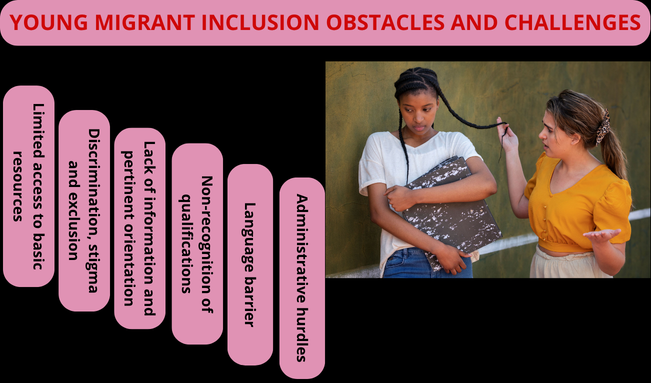
  1. Activity named obstacles young migrants often face: paperwork, language, qualifications that are not recognised, lack of information, discrimination and exclusion. Which of these feel closest to your own experience?
    Share only what you feel comfortable sharing. You can also answer with one word.
  2. Think of one difficult moment you faced since arriving in this country. What did you do to get through it?
    Think about the strengths you used, like patience, asking for help, learning fast or not giving up.
  3. Who or what helped you when things were hard? It could be a person, an organisation, a friend or a community.
    Think about how you could find this kind of support again, or how you could give it to someone else.
  4. Is there an obstacle you have not solved yet? What is one small step you could take this month?
    Examples: asking about recognition of your diploma, joining a language class, visiting a youth centre.
  5. How could taking part in circular fashion activities (repair, upcycling, second-hand projects) help you feel more included where you live?
    Think about new skills, new friends, or showing what you already know.

TOOL 2: CF-CAREER OPPORTUNITIES & STRATEGIES VIDEO

Multimedia resource & interactive activity

Instructions:

Mastering Circular fashion skills can enable young migrants to find a job in various business departments.

Choose YES or NO, when applicable.

Useful readings

Institute of Positive Fashion. (2025). Investment in circular fashion: Opportunities and success stories. British Fashion Council.

Ellen MacArthur Foundation. (2021). Circular business models: Redefining growth for a thriving fashion industry.

Self-Reflection

  1. The quiz showed that circular fashion skills are useful in many jobs: preparing materials, making clothes, packaging, transport, selling, repair and recycling. Which of these surprised you the most? Why?
    Think about whether your idea of “fashion jobs” has changed.
  2. If you could choose your dream job in circular fashion, what would it be? Why?
    Think about what you enjoy doing: working with your hands, with people, with numbers or with ideas.
  3. What skills do you already have, from your home country, your family or your past work, that could be useful in circular fashion?
    Examples: sewing, fixing things, selling at a market, speaking several languages, organising.
  4. What new skill would you most like to learn to get closer to this job?
    Think about where you could learn it: a training, a workshop, a volunteer project or online.
  5. What is one action you could take in the next few weeks to explore a career in circular fashion?
    Examples: visiting a repair café or second-hand shop, talking to someone in the sector, joining a training.

TOOL 3: CF-COOPERATION OPPORTUNITIES VIDEO

Multimedia resource & interactive activity

Circular fashion can enable the following professionals to cooperate.

Choose YES or NO.

Useful readings

BSR (Business for Social Responsibility). (2020, September 17). Taking a people-centered approach to a circular fashion economy.

Desa, I. S., Noviana, P., Yuniarsih, R. E., Farhana, Y., & Hasanah, N. (2023). Circular economy: The challenges and opportunity in fashion recycling. In M. M. Huda et al. (Eds.), Proceedings of the International Conference on Economics, Management and Accounting (ICEMAC 2022). Atlantis Press.

Self-reflection questions:

  1. The video showed that designers, tailors, scientists, service providers, local authorities and migrant entrepreneurs can all work together in circular fashion. Which of these groups would you most like to work with? Why?
    Think about what you could learn from them and what you could give them.
  2. Do you know any people or places near you that are already part of circular fashion? For example: a second-hand shop, a tailor, a repair café, a community project.
    If you don’t know any yet, how could you find them?
  3. What role could you play in your local circular fashion community?
    Examples: maker, repairer, seller, organiser, translator, someone who brings people together.
  4. Being a migrant can be a strength when people work together. What can you bring to a team that others may not have?
    Think about your languages, cultures, traditional techniques and your way of seeing things.
  5. Imagine starting a small circular fashion project with other people. Who would you invite? What would you do together?
    Think about one simple idea, like a clothes swap, a repair workshop or an upcycled product.

Co-funded by the European Union. Views and opinions expressed are however those of the author(s) only and do not necessarily reflect those of the European Union or the European Education and Culture Executive Agency (EACEA). Neither the European Union nor EACEA can be held responsible for them.

Project Number: 2024-1-DE02-KA220-ADU-000257214