Design a small-scale circular fashion project of your own using ideas from the powerpoint, Design thinking and Lean Startup methodology and the Social Business Model Canvas:
Ries, E, 2011. The Lean Startup: How Today’s Entrepreneurs Use Continuous Innovation to Create Radically Successful Businesses.
Eric, R. The Lean Startup website
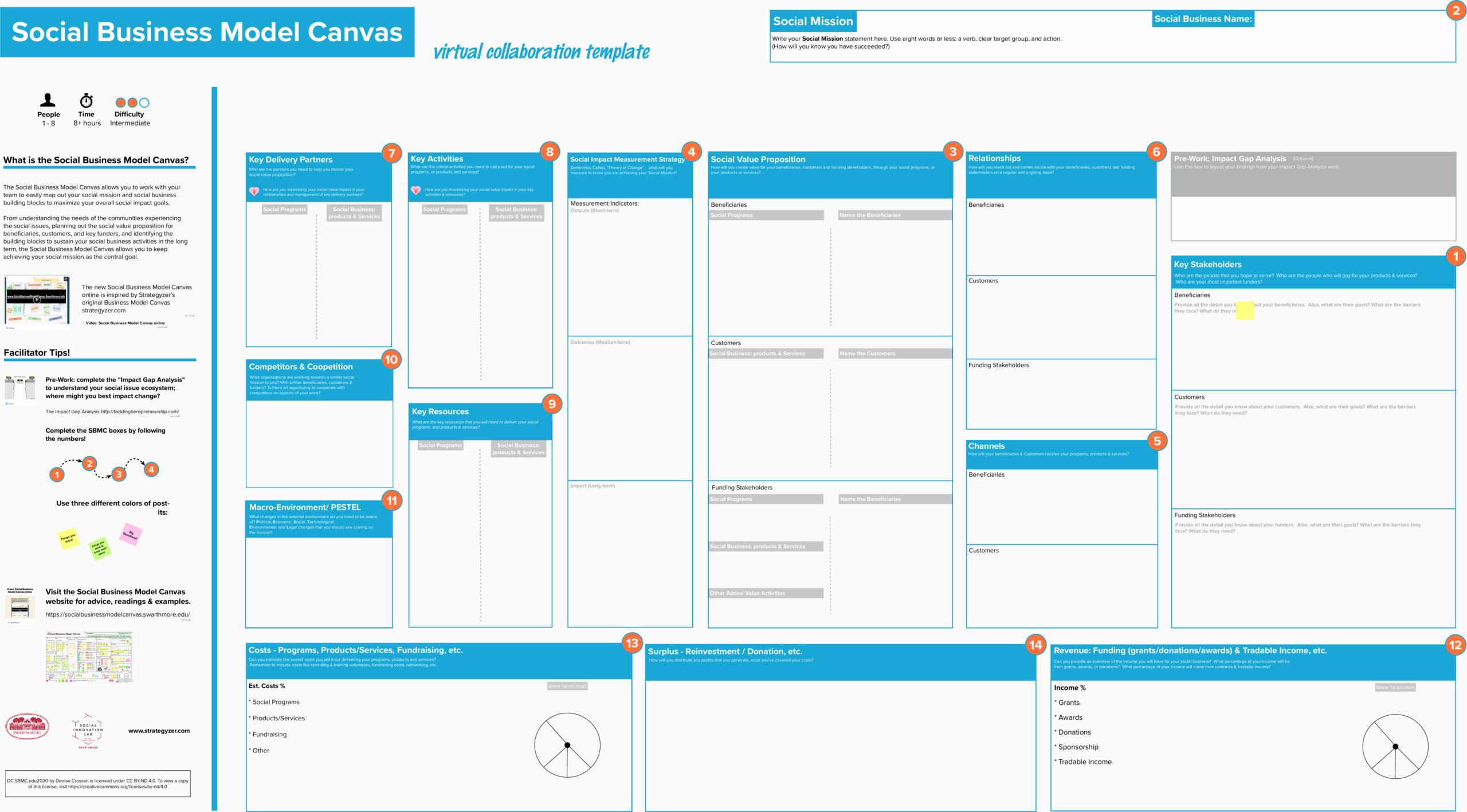
Social Business Model Canvas
Interaction Design Foundation, 2025. The 5 Stages in the Design Thinking Process.
Creately, 2025. Design Thinking Methodology/ Frameworks and Best Practices.
Change Clothes social enterprise in Dublin, Ireland is a community-based clothing reuse hub, which started small, when the founder, Mary Fleming began hosting monthly pop-up clothes swaps. Today, Change Clothes offers accessible second-hand fashion to swap plus delivers a variety of activities and events from its permanent premises, including rework sessions, repair sessions, and train-the- trainer training programmes for youth workers in clothes repair & upcycling. Additionally, they provide a range of initiatives aimed at creating positive opportunities for the community. They support Tus trainees (community work placement scheme for long-term unemployed) by providing work placements across their production service, swap store and scrap store, for example, working in small batch production to create products using second life materials which they sell in their swap shop. And through their Community Closet, Change Clothes provides clothing to people most in need by connecting with housing services and featuring a ‘free to take’ clothing rail in the store. They even lend anyone interested in running their own swap shop at a community event all of the necessary equipment for free.
Watch the video to learn more from Mary about Change Clothes.
Access the Change Clothes website and a template of the Social Business Model and use the information you’ve learnt from the video and website to fill out the Social Business Model Canvas about Change Clothes! You won’t know the answer to every box but see how much you’ve learnt!
Brief overview of the Social Business Model Canvas: The Social Business Model Canvas is an adaptation of the traditional business model: Business Model Canvas, an essential tool when launching a business. The SBMC model has been adapted for social enterprises to help social entrepreneurs outline how they create, deliver and capture value while focusing on social objectives.
The template features 14 boxes to complete including: Key Stakeholders, Social Mission, Social Value Proposition, Social Impact Measurement Strategy, Channel, Relationships, Key Delivery Partners, Activities, Resources, Competition, Macro-environment, and Revenue.
‘Change clothes’ website
Dublin City South Partnership. Social Entrepreneurs Ireland. Success story – Change Clothes.
Social Business Model Canvas
Ries, E, 2011. The Lean Startup: How Today’s Entrepreneurs Use Continuous Innovation to Create Radically Successful Businesses
Progetto Quid, a social enterprise in Italy was founded by young entrepreneurs in Verona in 2013. They use recovered, end-of-line, surplus fabrics and rework them into affordable, limited-edition, ethical clothing, employing 140 staff from disadvantaged backgrounds.
Circular Dress Collaborative is another inspiring social enterprise, based in Letterkenny, Co. Donegal, Ireland, dedicated to the principles of resale, repair, repurpose and rebuild.
LINA is the first online and offline fashion library in the Netherlands with a system for borrowing clothes, providing an extensive wardrobe for all occasions.
EtMoi, a Belgium-based circular fashion project involves local prisoners in the production of office textiles, such as chair cushions and card holders using conference lanyards and ties and scarves that are no longer worn.
Rediscover Fashion is a social enterprise in Ireland which produces 100% redesigned and repurposed clothing, accessories and homeware from unwanted textiles.
One of Rediscover Fashions stand out projects is their annual Relove Fashion Competition, a sustainable fashion competition which challenges secondary school students to use their creative design skills to design and create a rewearable, sustainable outfit using clothing sourced from a swap shop, charity shop or an item they have at home.
This activity has inspired me to consider creating a small-scale circular fashion project of my own.
Initiatives: Let’s Match Mums
Let’s Match Mums provides a matching service for mums with children’s clothing to donate with refugees in need of clothing for their children. It’s a great example of providing a circular fashion project that is really needed!
Interactive activity:
Get inspired by the Let’s Match Mums idea and brainstorm an idea for a circular fashion social enterprise project. Chat with real, potential users of your idea and create an empathy map (Design thinking) based on these discussions:
IxDF (Interaction Design Foundation). Empathy Mapping.
HubSpot, Blog. What is an Empathy Map and How to Create One.
Reflect on the idea for Let’s Match Mums social enterprise.
Reflect on your own idea – what benefits does it bring?
What impact did chatting to potential users of your idea have?
How did empathy mapping help you gain a better understanding of your potential users’ needs?
Read further about empathy mapping and reflect on its positives.

Co-funded by the European Union. Views and opinions expressed are however those of the author(s) only and do not necessarily reflect those of the European Union or the European Education and Culture Executive Agency (EACEA). Neither the European Union nor EACEA can be held responsible for them.
Project Number: 2024-1-DE02-KA220-ADU-000257214


